

Ram Dange came to Ukraine in the turbulent 1990s, even a little earlier. Unlike his fellow countryman Lakshmi Mittal, the ferrous metallurgy tycoon, who purchased Kryvorizhstal Metallurgical Works, the biggest in our country, Ram could not even afford to buy a fax machine to send copies of documents, so he had to do it at the Central Post Office on Khreshchatyk Street. Today, Ram has a completely different status, although he has not reached the amount of Lakshmi Mittal’s fortune and has not even set such a goal, but he is still a prominent figure in the food market.
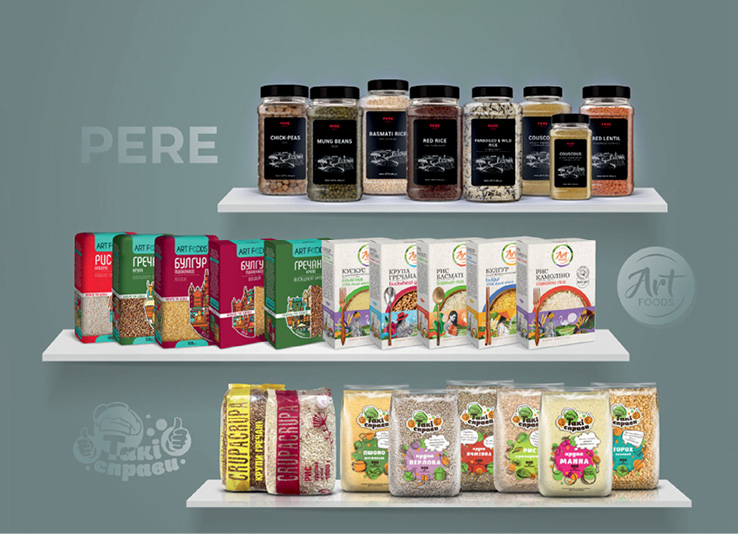
Two of his companies – Indrayani Overseas and Gala Foods – have won the trust of the chain trade giants such as Silpo, Metro C&C, Auchan, Velyka Kyshenia and others, and become one of the main importers of rice crops to Ukraine. The packaging lines of the Indian entrepreneur’s company supply the supermarkets with such well-known brands producing grains as PERE, ART FOODS, and Taki Spravy.
This is the story of a foreigner who has perfectly integrated into the agricultural environment of Ukraine, and into our community as a whole. The chaos of the first years of our country’s development did not deter him from his activities, as well as the war that broke out in February 2022. He runs his business not from Europe or India, but from his office located in the outskirts of Kyiv.
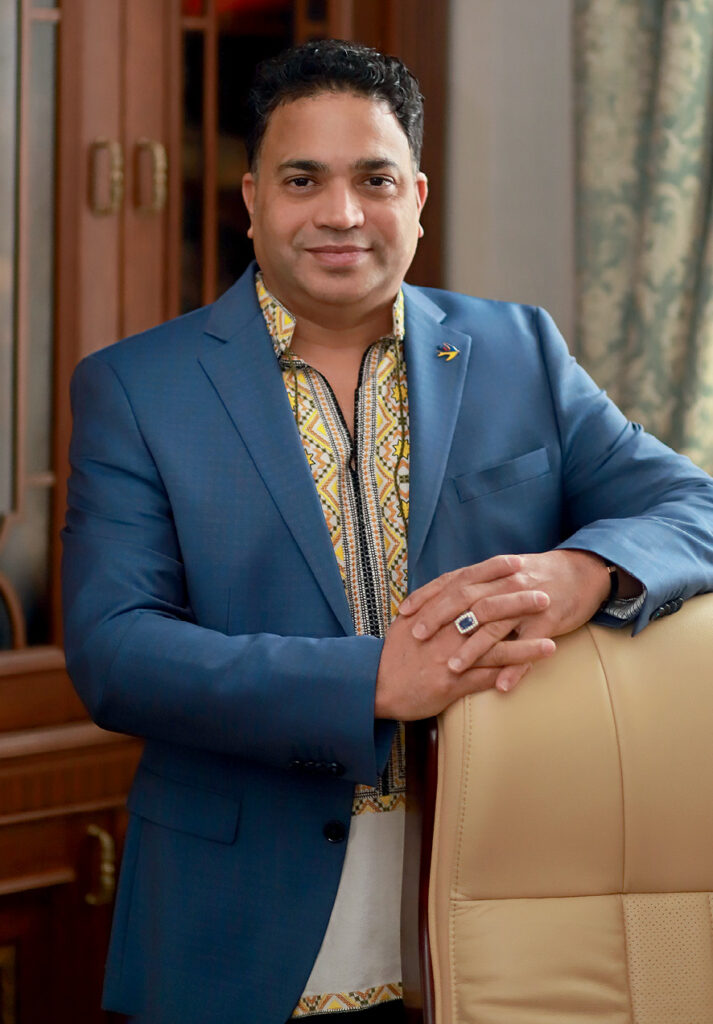
We had our interview at this place, in the single-family neighbourhood of the city, in a rounded house looking like a small palace surrounded by numerous rose bushes. It is winter now, and we have a lot of snow around, but two months ago, during our first meeting, we enjoyed rose buds blooming in the garden. The interior of the house is made in Indian style, with typical wall patterns, paintings, and figurines. Indian carpet, inlaid with semiprecious stones, a traditional handmade piece of interior, usually manufactured in the northwestern state of Rajasthan, reminds Ram and his family of distant India.
‘Ram, I believe you had a chance to study in some other country in prosperous and reliable Europe, not to mention the United States. Why did you choose Kyiv?’
‘Our family was not very rich, and my father, who had worked as a civil servant, later became engaged in horticulture, like many of our ancestors. Studying in the Great Britain or the United States was quite expensive, and I was looking for some government-supported programs to study abroad. So, I could afford studying in the USSR only. I had found people who were able to give me a hand in this matter, collected the necessary reference letters and went first to Tashkent, then to Kyiv. I did it in the late 1980s. We expected to see a powerful state to compete with the United States, but it was something completely different, with its poverty and endless lines at the stores. The empire was falling apart. Learning the language was my first and most important objective. This was the first major milestone, and overcoming it gave me the key to my future success. Despite all the disappointments, I realized that I would get the necessary knowledge.’
Planes and Bags
‘Where did you get your education, what was your specialty?’
‘I studied at the Kyiv Institute of Civil Aviation Engineers, now National Aviation University (NAU). There were three aviation universities in the Soviet Union – KICA, MICA, and RICA,’ added Ram with a smile.
‘That’s incredible! Did you want to become a pilot?’
‘No, actually, I had studied to become a computer engineer with a specialty “computer technology in civil aviation”, but I didn’t work in this area, because in the 1990s, when we were finishing our studies, there had been incredible opportunities opened up in the country for people who spoke two languages – native and English or some other foreign language. The collapse of the Soviet Union cut off all trade ties between Ukraine and the world, because during the Soviet era, Ukraine was buying or selling goods in a centralized way through moscow, that was why the country had no direct business contacts at all. They had no idea how to do all procurements, how to buy even the most essential goods, including rice, raw tobacco products, coffee or jute bags made in India. Importers had no idea either. So, establishing these connections had created tremendous opportunities for our generation. I immediately realized that it was my chance to succeed here in Ukraine!
As early as my final year of study at the institute, the Embassy of India engaged me in meeting business delegations, then invited me to participate in international meetings of various ministries and state institutions in Kyiv. These were delegations representing a wide variety of industries – telecommunications, textile, chemical or other industries, so I had an opportunity to establish extensive connections. First of all, I mostly helped Indian businessmen. I was assisting them in concluding and performing trade agreements and received commission fees for my activities. Upon graduation from the institute, I was already working as a commercial agent for several Indian companies engaged in various industries such as selling raw tobacco products, haberdashery products, and or jute bags. So, the issue of working in the aviation area became irrelevant for me. I started my own company to import various goods to Ukraine.’
‘So, first you started importing something other than rice?’
‘That’s right. Rice importing was still a long way off at that time. I started with safety razors (traditionally supplied to the country during the Soviet era), toothpaste, and haberdashery and leather goods. Later, I started supplying raw tobacco products for Ukrainian factories. The next activity of mine was importing or jute bags for Ukrainian sugar producing facilities. Throughout the USSR, sugar products were traditionally packed in or jute bags. Importing rice was the next step.’
‘What was the first big amount of money you had earned on your own? And what was your best deal?’
‘I will always remember how I earned my first $50,000. I had set the objectives for a quarter of the year, and a month of the year, wrote them down in my notebook, and every 15 days I calculated how much money I had earned to reach that figure, and wondered whether I would get that amount at the end of the quarter. So, step by step, I earned my first $50,000. It was a very important process for me, which made me feel confident. And when I got not just $50,000, but $500,000, it was already not such a significant event, because I had already been going the well-trodden path, and the most difficult thing was to earn my first big money. As for the most successful deal of mine, it was selling or jute bags.
Offering the available samples of or jute bags, I found two potential buyers in Ukraine in 1995 – one small and another so well-known and important that I still feel impressed by the scale of that transaction. It was Ukrprominvest, which had previously been buying such bags through an intermediary. I arranged that the company worked directly with an Indian manufacturer. And later, this manufacturer began to sell or jute bags to half of Ukrainian sugar producers.’
‘And what about rice? When did you start to import it?’
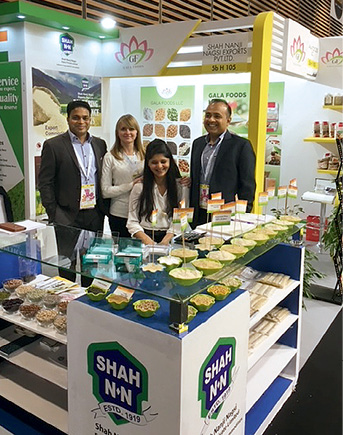
‘The thing is that I was always looking for new opportunities, and once I heard that India had been buying Ukrainian yellow peas, and I took a flight there in search of relevant consumers. During my business trip, I made the acquaintance with a major rice exporter who supplied it to various countries. Today we are partners, representing ourselves as one business family at various world trade fairs. He showed me the prospects of rice importing business, and it really appealed to me. At first, I imported the most popular rice varieties to Ukraine, then I began to supply its exotic varieties, increasing their share and expanding the geography of supplies: from India to Pakistan, Thailand, Vietnam, Cambodia, Myanmar, Uruguay and other countries, and even the South American continent with its wild rice export.’
Packaging Business
‘But what about Ukrainian yellow peas – do you export them? Maybe some other crops, too?’
‘We export yellow and green peas, processed and unprocessed, and we also export chickpeas, other beans and legumes, millet, flax seeds, lentils, and mustard seeds. We procure these crops from Ukrainian farmers. We also supply the above products, as well as buckwheat, to the Ukrainian market. In recent years, we also started delivering bulgur, couscous, quinoa and other imported grains to the Ukrainian market.
We have quite a lot of partners among Ukrainian farmers, with their number growing every year. The partnership we offer is transparent. New suppliers are always welcomed, but only provided the requirements of quality criteria and honest relationships are met.’
‘I guess, for this purpose you also needed your own packaging business, too’.
‘Yes, that’s right. When you are doing business, there comes a time when you realize that you have to start developing some new area. I was always keen on production, but, as a matter of fact, I never liked the idea of developing really big production facilities with smoking pipes and all the stuff, but I rather welcomed the idea to launch some trade-related business. We were selling big batches of rice and other grains, but I observed that supermarkets offered a large variety of rice supplied by other companies. The reason was that we had no packaged products. And it was the packaged products that people are buying in the supermarkets every day – one family today and tomorrow it is another family. I realized where I was dropping. So, the next step was introducing our products in supermarkets. We invested in the packaging business to enter Ukrainian retail sector. In order not to waste time building our own production facility, we bought a ready-made enterprise in Boryspil, which manufactured its products under the ТМ ART FOODS. Simultaneously, we purchased such well-known brands in the low-price segment as Taki Spravy and top-ranked PERE. Moreover, the latter was significantly rebranded, and we began to pack the products of improved quality in special plastic cans with a recognizable black-and-red label having no analogues in this segment. At the same time, we were still engaged in selling grains by weight in bulk, as it had been long-standing and largest area of our business. By selling our grains through various sales channels, we strive to be present in all segments.’
‘What is the difference between the two companies of yours – Indrayani Overseas and Gala Foods? Are they focused on different markets?’
‘Yes, that’s right. Indrayani Overseas is my first company which presently celebrates its 25th anniversary. From the very beginning, it was focused on many areas, starting from the import of polypropylene bags and jute fabrics, and later raw tobacco products and various grains. Eventually, our area of activities extended to the export of grains. In recent years, it is export and import operations with grains that have become its core business activity including wholesale trade of bagged grains. As for Gala Foods, it is engaged in procurement of imported grains and grains produced in Ukraine, their processing, packaging and sales in the Ukrainian market and exporting. These are packaged products manufactured under our trademarks, as well as house brands of the largest national chains of Ukraine and some European countries. We are proud that Gala Foods is the only company in the packaged grains industry that complies with the BRCGS Global Standard for Food Safety.’
‘Are you the major importer of rice to Ukraine? What is your market share and annual money turnover?’
‘It’s likely enough that we are the largest importer of rice in Ukraine, with our share in its total imports making up at least 20%. We are also making every effort to extend our exporting capabilities on an ongoing basis, in particular, in the current year of war, we have achieved the result twice as much as last year, ranking among the top ten Ukrainian exporters of niche crops. Export area is very important to us. This was made possible due to the strong partnership with our suppliers – experienced producers and processors of niche crops. However, I would like to point out that these figures have never been the only goal for us – just to become the largest export and import company. The most important thing is to make a certain profit, achieve the necessary financial performance, and not just wear a T-shirt of the largest importer or exporter of Ukraine, meanwhile having debts owed to a bank. Our annual turnover in terms of two companies reaches almost 1 billion UAH.’

‘Have you had any underperformances in 25 years?’
‘In today’s context, we realize our biggest mistake we have made in running the Gala Foods business – in the pursuit of becoming successful in supermarket chains, we barely focused on the market sector and distribution, which represented significant extra sales channels. It is not easy to work with the national retail chain, as supermarkets often do not adhere to financial discipline and dictate their own terms. Therefore, focusing only on these networks means blocking your finances for a long time. We weren’t much concerned about developing our packaged products’ distribution sector and establishing contacts with medium and small regional chains and distributors, and that was our blunder. Now we do our best to fix it.
Perhaps it would be appropriate for the government to adopt some decision that would regulate the terms and conditions of payments made by distributors to their suppliers, especially in terms of the national and regional networks, as the prolonged delay in payments hampers, and sometimes even disables the development of processing companies belonging to small and medium-sized businesses.
One more thing. Business relating to grains production, and it particularly concerns exporting raw materials, requires additional processing to meet the standards of quality indicators. If we had previously developed the necessary infrastructure that renders services to all the processes of our business (such as storage, fumigation, final cleaning, possible processing, additional preparation of products for export), we would have been even more successful.’
Don’t Burn Bridges

‘Farmers face a lot of risks such as droughts or floods, or excessive heat, or discouraging prices set for their products. What are the risks you face in your business?’
‘You always have to find the most appropriate price, the procurement price that, when delivering the product to Ukraine, would provide certain “rainy-day fund”, so you would not lose everything even if you fail. It is necessary to be able to “catch” a good price in the off-season or depending on different situations in foreign markets. And, as you know, this is not a one-time matter, it means constant efforts and ongoing monitoring. And rice must be imported on the ongoing basis, for the consumers in the market require it all the time. Product packers also need uninterrupted supply of rice. It is too difficult for anyone else to follow these trends in different countries and participate in competitive bidding, but we have vast experience and are already professionals in this area.
As for the risks we face, the current logistical difficulties incur extra costs, the amount of which is difficult to predict. Isn’t it a risk to import too expensive goods? Taking into account the fact that Ukrainian ports are under constant danger of russia’s shelling or attacking by kamikaze drones. Besides, there is no such a concept as insurance today, so entrepreneurs bear the risk for importing their goods on their own. And the goods may get damaged or destroyed due to the war and difficulties in logistics. Therefore, we have enough risks to face.
One of the most important factors is our constant presence in the market. Being in the market for 25 years, we know it from A to Z.’
‘What personality traits are necessary to become such a high-flying businessman like you? Do you happen to have any conflict situations? How do you manage them?’
‘The ability to communicate and negotiate is very important in our business. First of all, if you have no proper levers to influence the situation. As a matter of fact, sometimes we have to apply to the court, and we have powerful lawyers to defend our rights. However, courts and government authorities, especially Ukrainian ones, are not always capable of resolving some issues, as it takes too much time, it is weary, and quite often even absurd. And it might be ridiculous to apply to The Hague court to have some of your commercial issues resolved.
Therefore, we have to solve our problems on our own, through negotiations. It is much easier to explain a person over a glass of wine the trouble our conflict could make to both of us. It may be your fierce competitor, or a person who dislikes you, or even hates you, but that doesn’t mean you have to feel hostile towards him or her, either. You should catch even the slightest opportunity to create a better image of you in your hater’s mind. And then you should promote this amity and turn your hater into at least a business partner, if not a friend.
That means trying not to burn bridges, but build them up. Naturally, diplomacy is not enough, courage and assertiveness are also very important traits’.

Majestic Rice
‘Rice is the main product you sell on the market. I guess that you already know everything about it. What kind of rice do the Ukrainians give their preference to?’
‘Rice is among the most important products we sell. There are more popular and demanded inexpensive varieties of rice, and elite varieties. It hinges of the country it is cultivated in, and weather conditions. It is only the rice of mass consumption that is common for all countries. White round grain, long grain polished and parboiled rice varieties have the highest demand among Ukrainians, the same as among consumers all around the world.
However, those who are keen on healthy foods prefer other varieties of rice: brown, red and black. We offer red and black rice delivered from Thailand. Aromatic Jasmine rice grows only in Vietnam and Thailand. As for Basmati, the king of rice, they grow it only in the Indo-Pakistani valley, at the foot of the Himalayas. There is also wild rice delivered from the Latin America, which grows in the wild, therefore it is more expensive than other rice varieties.
Round grain rice is the most popular among Ukrainians, moreover, it was grown in Ukraine before the war, in Odesa and Kherson Oblasts. And earlier it was grown in Crimea. Long grain and parboiled rice are also rather popular in Ukraine. As for unpolished and exotic rice, they have very low demand in the country so far. This is the same as with buckwheat – raw green buckwheat is much less popular than its brown steamed variety. As a rule, only those who care about healthy diet prefer to buy green buckwheat. It is the same thing with rice.
Every year, we import 16,000-25,000 tons of rice of various types to Ukraine. Moreover, we offer the widest range of rice varieties to our customers.
In many countries of the world, primarily Asian and African ones, rice is a social food, as potatoes or bread in Ukraine. It literally feeds most of the population of the planet Earth.’
‘Three months ago, India banned the export of white rice…’
‘Yes, India has put a ban on exporting long grain rice, which is very popular in Ukraine, as the country needs to build up some stock of it. It made the price of rice go up, which affected our prices too, and there is a risk of losing some share of Ukrainian consumers. But, fortunately, we import this variety of rice not only from India, but also from Pakistan and Vietnam, although in much smaller volumes.’
‘What Ukrainian agricultural products may be demanded by the Indian market?’
‘India is the world’s largest consumer and importer of pulses, with their annual import volumes making up millions of tons. That is why Ukrainian niche crops, and above all raw yellow peas, have great prospects in terms of their export to India. Earlier, India was importing large volumes of peas from Canada, Australia, russia and Ukraine, but five years ago, importing of yellow peas was banned to support India’s own production facilities. Recently, India lifted this ban until March 2024, so Ukraine has all the opportunities to export this product in large volumes. India is also the world’s largest importer of Ukrainian sunflower oil.’
Logistics in the Wartime
‘How did the war affect your business, and how do you solve logistics problems?’
‘With the beginning of the war, many importers stopped doing business in Ukraine, not having enough capabilities and willing to withstand all the difficulties. In a week after the war broke out, wherever it was possible, in Zhytomyr and Odesa in particular, we opened up our warehouses, working double shifts, helping our customers, our population, and the country. We had been supplying these customers for years and couldn’t just leave them, despite the danger. It was important for us that people knew that in the times difficult for our country we did not just hide. Due to the closure of Ukrainian ports, we were the first importer of the industry to begin importing grains from Turkey, Bulgaria and Romania via land routes across the western borders of Ukraine, and we still do it. Later, sea routes began to operate through the ports of neighbouring countries – Constanta (Romania), Gdansk and Gdynia (Poland), as well as transporting by rail to the ports of neighbouring countries. In terms of capacity, European ports cannot be compared with Ukrainian ones, therefore we often have delays, downtime, and have to wait in line. All routes are overloaded, and there is a shortage of railway grain carriers, containers, and cars.
Last year, our export volumes decreased significantly, but this year they are already growing both in terms of exports and imports. Of course, we have not achieved the outcome of 2021, but we are gradually reaching it. As the logistics leverage has increased, the cost of sea freight and any transportation has also increased. It entailed significant increase in the cost of imported goods.
The war disrupted all our plans. We were supposed to have already started building our own and completely new energy-efficient production facility in Boryspil to bring together all the processes necessary for our business relating to various types of grains, including cleaning, fumigation, processing and preparation for packaging – in short, it was supposed to be one integrated facility to manufacture products from raw supplies to be exported and sold in the Ukrainian market. That was our big dream, and the war made us postpone its fulfilment.’
‘I know that you aid the Armed Forces of Ukraine, volunteers, and communities.’
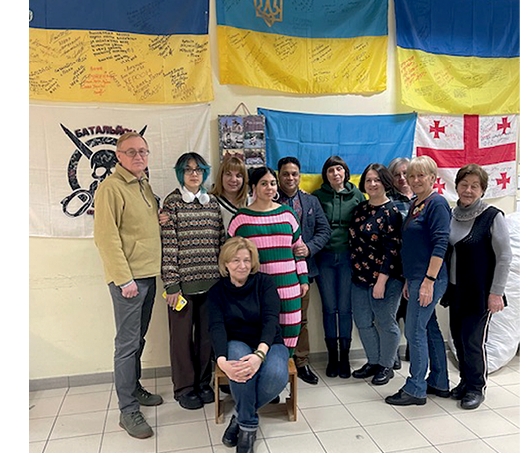
‘We have been helping volunteers since 2014, and since the Maidan events, we have been collaborating with the “Sitka” Battalion (Battalion “Net”). Also, we arranged all-Ukrainian children’s patriotic art contests. Since the beginning of the full-scale war, our support for various volunteer organizations has increased significantly. From the first months of the war until the end of last year, we provided to some volunteer organizations (such as “Field Kitchen B-50”, “Team M – Volunteer Assistance Headquarters” and others) our products free of charge to cook meals for displaced persons and deliver food to the front line. We strongly support the operation of the “Army of Volunteers”, who provide assistance to the Armed Forces of Ukraine and displaced persons, and we gave our own office in Kyiv to house this organization. We regularly provide our assistance to the initiative “Borscht for the Armed Forces of Ukraine”. They make various premixes for cooking and grocery sets. We donated “Peremoha” (“Victory”) field kitchen for a scout squad of the Armed Forces of Ukraine located in Chernihiv Oblast, which makes it possible to cook meals for 100 military personnel simultaneously. When the only ambulance car of a village first-aid station of one of the districts in Chernihiv Oblast burned down due to the shelling, we, together with our fellow Indian entrepreneurs, purchased and donated the community the car they needed.’

Family, Roses, and Ukraine
‘I believe that you feel more Ukrainian now than Indian. You married a Ukrainian woman, and your children grew up here. Do you have spare time to enjoy it with your family?’
‘Ukrainians are very friendly people, I have never experienced any biases or racism in this country, and therefore it was easy for me to integrate into Ukrainian society. I am very proud that once I gave preference to this particular country, and that it is here that I have grown as a businessman.
On the other hand, my wife Galyna was also happy to accept Indian culture and cuisine, and she cooks both Indian curry and Ukrainian borscht very good.
Being a believer, I often go to the Ukrainian churches. It is the same as the Indian temple for me. I don’t mean the decoration, but the feelings they evoke. When you live following these traditions, enjoy the same holidays as Ukrainians, and share all their pain and suffering, you become a part of their community. And if some misfortune happens, you don’t feel like a stranger among Ukrainians, and it has a heeling effect on your soul, it inspires you to move on.
Surely, it is the family that inspires us on our way. If you have no one to share your success or misfortune with, life becomes even more complicated. I’m doing my best to be able to spend more time with my family, but I have to admit that my efforts are not enough yet. My youngest daughter is growing up so fast, time flies, and now my eldest daughter already supports me in my business. The money we earn should bring us happiness, we should not spend our lives just to earn it and never enjoy it. What for?!’
‘Your wife’s name is Galyna, and your daughter’s name is Greta…G seems to be your favourite letter, right?’
‘Moreover, our company is called Gala Foods, and there is also my revered god Ganesha, the god of good luck and wisdom, the patron saint of business people,’ said Ram with a smile. ‘We live in Europe, so we chose modern European names for our children.
We travel to India by plane in winter, it is still rather green there. Normally, the temperature at this time of the year is about +10°C, it sometimes gets frosty, but only in the morning. My parents are already gone. They lived in a private house with a tangerine garden in a city with a population of about three million. Our family has had many generations of landowners. So, our parents taught us from childhood to take care of the garden, and they believed that physical labour made people more self-disciplined, and accustomed them to work hard.’
‘Do you teach your own children to take care of roses growing around your house in Kyiv?’
‘No, I don’t. This is just my hobby. I recreate there, among my roses. There are 56 rose bushes, and I know all their names and can tell them apart by their scents. This is kind of extra meditation for me, after working out in the gym, doing various exercises and yoga together with my family. Today, in the frantic pace of our lives, when we face so much stress, fuss, and now war, one can’t do without it.’
‘Do you believe in the victory of Ukraine?’
‘I do! Otherwise, I would have left the country. Ukraine is the best possible country for us to live in. This faith should be like a prayer for all of us. If each of us, despite all the grave circumstances, challenges and difficulties, would keep on working as before, then the country would have more capabilities and possibilities to get one step closer to the victory and become even more successful than before the war.
I had been observing how this country was constantly changing. – from “shuttler traders” to successful farmers who even during the wartime are showing great results. Positive changes were so obvious, and only weak-minded people saw negative tendencies only. Every country faces challenges arising now and again. Their overcoming depends on the readiness of the country, society, business, and the economy as a whole to face them. Today, India has a well-developed economy, but the country celebrated 75 years of independence last year, and this is twice as long experience of independence as the experience of Ukraine. And you won’t need 75 years, because you have a different level of opportunities, resources, geographical location, and motivation.
My heart aches to see all the suffering that the Ukrainian people are experiencing because of the brutal war unleashed by russia. I am so proud of the courage and perseverance of the Ukrainian military, and their valour. However, I am no less inspired by the dedication and strength of Ukrainian farmers, who in difficult wartime, with shelling going on, and farm machinery operators tripping russian landmines, and the price for their products getting lower than ever, and when there seems to be no motivation to move on at all, they still go out to work in their fields every morning. As before the war. As usual.
Ukraine has already made the world feel surprised and this is not the end. It will be independent and powerful state, with huge opportunities both for Ukrainians and for other people who will come here to rebuild and develop it.’



 2026-06-12

